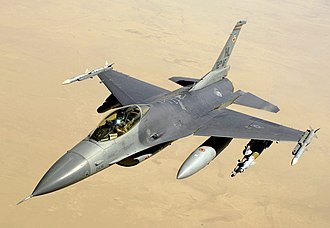
The General Dynamics F-16 Fighting Falcon is an American single-engine supersonic fighter, originally developed for the U.S. Air Force as a day fighter but later evolved into an all-weather multirole aircraft. Over 4,600 have been built since 1976. Though no longer bought by the USAF, upgraded models are exported. In 1993, General Dynamics’ aircraft division was sold to Lockheed, now Lockheed Martin.
Key features include a frameless canopy, side-mounted control stick, reclined ejection seat, and a fly-by-wire system. It has a single turbofan engine, an M61 Vulcan cannon, and 11 hardpoints. Nicknamed the “Viper” by its pilots, it serves with the USAF, Air National Guard, Thunderbirds, Navy aggressor units, and 25 other countries. As of 2025, it remains the world’s most common military fixed-wing aircraft, with 2,084 in service.
Development
Lightweight Fighter program
After the Vietnam War, the U.S. recognized the need for better air superiority fighters. Colonel John Boyd and Thomas Christie developed the energy–maneuverability theory, advocating for a lightweight, highly maneuverable fighter. Boyd’s “Fighter Mafia” helped launch the Lightweight Fighter (LWF) program in 1971. The Air Force, unable to afford enough F-15s, supported the idea of a cheaper complementary fighter
General Dynamics’ YF-16 and Northrop’s YF-17 were selected for prototypes. The YF-16 first flew in 1974, including an accidental takeoff during taxi tests. A competitive flyoff showed the YF-16’s superior agility and cost-efficiency.
Air Combat Fighter Competition
The LWF evolved into the Air Combat Fighter (ACF) program to meet U.S. and NATO needs. After rigorous testing, the YF-16 won in 1975, praised for its performance, cost, range, and engine commonality with the F-15. The USAF planned to buy up to 1,400 F-16s. Meanwhile, the Navy adapted the YF-17 into the F/A-18 Hornet.
Production
The U.S. Air Force ordered eight full-scale development F-16s, with the production model featuring a longer fuselage, larger wings, upgraded radar, and other improvements, increasing weight by 25% over the prototype. The first F-16A flew in December 1976, and operational service began in October 1980 with the 388th Tactical Fighter Wing. Though officially named “Fighting Falcon,” crews often call it “Viper.”
In 1975, Belgium, Denmark, the Netherlands, and Norway ordered 348 F-16s, with European co-production launched at factories in the Netherlands and Belgium. Deliveries to European air forces began in 1979.
Later, Turkey’s TAI produced 232 F-16s for its air force, with additional units for Egypt. Korea also produced 140 KF-16s. By 2013, Lockheed Martin expected F-16 production to continue until at least 2017.
Improvements and upgrades
- Stall Fix: Increased horizontal stabilizer size by 25% and added a manual override switch.
- MSIP Program: Gradual upgrades added new capabilities at lower cost and risk.
- 2012 Upgrade: $2.8 billion allocated to upgrade 350 F-16s (added auto-GCAS, improved avionics).
- Upgrade Limits: Power and cooling capacity restrict how much can be upgraded.
- Contractors: Lockheed Martin handled most upgrades; BAE Systems lost key contracts.
- CAPES Cancellation: Budget cuts in 2013 canceled some upgrade plans, but basic life extension continued.
- Service Life Extension (SLEP): USAF planned to extend the life of 300 F-16 C/Ds.
Design
Overview
The F-16 is a single-engine, highly maneuverable, supersonic, multirole tactical fighter. It’s smaller and lighter than earlier fighters but uses advanced technology, like the first relaxed static stability/fly-by-wire (RSS/FBW) flight control system, to improve maneuverability. It was the first fighter designed for 9-g maneuvers and can fly at speeds over Mach 2.
Key innovations include:
- A frameless bubble canopy for better visibility (Experience it here)
- A side-mounted control stick for better pilot control
- A reclined seat to help pilots withstand high g-forces
It is armed with:
- An internal 20 mm M61 Vulcan cannon in the left wing root
- Multiple hardpoints for carrying missiles, bombs, and pods
Its thrust-to-weight ratio is greater than one, allowing it strong climbing and acceleration ability.
Design and Construction
The F-16 was built to be affordable and easy to maintain. Its airframe is made of:
- 80% aluminum alloys
- 8% steel
- 3% composites
- 1.5% titanium
Innovations in construction include:
- Bonded aluminum honeycomb and graphite epoxy coatings for key structures
- Fewer lubrication points and fuel line connections
- 80% of access panels can be reached without using maintenance stands
The air intake was carefully positioned for optimal airflow and reduced drag.
Structural Strength
Originally, the Lightweight Fighter Program (LWF) required a 4,000-hour airframe life at 7.33 g with 80% internal fuel.
However, General Dynamics designed the F-16 for an 8,000-hour life and 9-g maneuvers at full fuel, allowing it to easily adapt to multirole missions.
As missions changed and more equipment was added over time, the F-16 underwent several structural strengthening programs to handle the increased weight.
General Configuration
The F-16 features a cropped-delta wing design, which improves its agility by using vortex lift for better control at higher angles of attack. Key features include:
- Wing Design: A slender wing with a 40° leading-edge sweep and straight trailing edge, optimized for maneuverability.
- Wing Extensions (Strakes): Short triangular wings extending from the fuselage to the wing root, which help generate additional lift and stability by creating a vortex flow.
- Aerodynamic Control: Variable-camber wings with leading and trailing-edge flaperons, controlled by a digital flight control system, help manage the aircraft’s flight envelope for better agility.
- Intake and Engine: A fixed-geometry air intake supplies the single turbofan jet engine. The nose gear deploys behind the air intake.
- Tail Design: The F-16 has an all-moving “stabilator” tailplane and ventral fins for improved stability.
- Landing Gear: A tricycle landing gear system with an aft-retracting nose gear and a tailhook under the fuselage for carrier operations.
- Refueling and ECM: An aerial refueling receptacle behind the canopy and a fairing under the rudder for ECM equipment or a drag chute.
- Dorsal Fairing (Later Models): Houses additional equipment or fuel.
These aerodynamic features, combined with a moderate wing loading, help the F-16 achieve superior maneuverability and agility in combat.
Cockpit and Ergonomics
The F-16 cockpit offers exceptional visibility thanks to its bubble canopy, providing 360° all-round visibility. The pilot has a 40° downward view over the sides and a 15° downward view over the nose. This is achieved by elevating the pilot’s seat and omitting the forward bow frame that obstructs vision in many other fighters.
- Ejection Seat: The ACES II zero/zero ejection seat is tilted back at a 30° angle, higher than the typical 13–15° in other fighters, increasing g-force tolerance but sometimes causing neck discomfort.
- Side-stick Controller: The F-16 uses an armrest-mounted side-stick controller (rather than a center-mounted stick) and throttle. The HOTAS (Hands On Throttle and Stick) system allows for better control during high-g maneuvers.
- Head-Up Display (HUD): A HUD projects flight and combat data in front of the pilot to keep their head up and improve situational awareness. Additionally, multi-function displays (MFD) show more flight and system details.
- Night Vision Compatibility: The Mid-Life Update (MLU) enabled compatibility with night-vision goggles (NVG), improving nighttime operations.
- Helmet-mounted Cueing System: The Joint Helmet Mounted Cueing System (JHMCS) allows targeting based on head movement, making it easier to fire high-off-boresight missiles. A newer system, Scorpion Helmet Mounted Display, will replace the JHMCS in the future.
In 2024, the USAF awarded a contract to Terma A/S for a new 3-D audio system to enhance communication and improve threat detection by spatially separating audio signals and integrating noise reduction.
Fire-Control Radar
The F-16A/B was originally equipped with the Westinghouse AN/APG-66 radar. This radar was designed to be compact, fitting into the F-16’s small nose, and included multiple modes for different combat situations, even in challenging weather. It featured four frequencies within the X band and was capable of look-down/shoot-down to detect targets in cluttered environments.
- Upgrades:
- APG-66(V)2: Improved signal processing, higher power, better reliability, and increased range in difficult environments.
- APG-66(V)2A: More speed and memory added in the Mid-Life Update (MLU).
The AN/APG-68, introduced with the F-16C/D Block 25, was an evolution of the APG-66, offering greater range, resolution, and 25 operating modes, including ground-mapping, Doppler beam-sharpening, and track while scan (TWS) for up to 10 targets. The radar was also made compatible with the LANTIRN targeting pods and featured a new high-PRF pulse-Doppler mode for use with semi-active radar homing missiles like the AIM-7 Sparrow.
- Further Upgrades:
- APG-68(V)1: Full compatibility with LANTIRN pods.
- APG-68(V)5: A more reliable version used in Block 50/52 F-16s.
- APG-68(V)9: A major upgrade with 30% greater detection range and synthetic aperture radar (SAR) for high-resolution mapping.
The F-16E/F is equipped with the AN/APG-80 radar, an active electronically scanned array (AESA). The latest AESA radar for the F-16 is the AN/APG-83 SABR radar, designed by Northrop Grumman. This radar upgrade improves capabilities significantly, including all-weather targeting and better precision weapons guidance.
- In 2020, the USAF extended the service life of the F-16s to at least 2048, with upgrades including the AN/APG-83 radar as part of their service-life extension program (SLEP).
Propulsion
The F-16 uses a single-engine turbofan for power. Initially, the aircraft was equipped with the Pratt & Whitney F100-PW-200, a modified version of the F-15’s engine, producing 23,830 lbf (106.0 kN) of thrust. However, during testing, issues such as compressor stalls and “rollbacks” (where the engine spontaneously reduces to idle) were found. These problems were eventually resolved, and the engine became standard on early F-16s through the Block 25.
- Upgrades:
- The F100-PW-220 engine, introduced with the Block 15, improved reliability with a Digital Electronic Engine Control (DEEC), reducing stalls and increasing stability.
- The F100-PW-220E (introduced in 1997) further improved engine reliability and reduced unscheduled engine removals by 35%.
The F-16’s engine selection expanded under the Alternate Fighter Engine (AFE) program, which led to competition between Pratt & Whitney and General Electric for engine contracts. General Electric’s F110-GE-100 engine provided 25,735 lbf (114.47 kN) thrust, but with the Modular Common Inlet Duct, it could achieve up to 28,984 lbf (128.93 kN). The F-16s using General Electric engines are identified by blocks ending in “0” (e.g., Block 30).
- Later Engine Upgrades:
- The F110-GE-129, part of the Increased Performance Engine (IPE) program, was introduced on the Block 50 with a thrust of 29,588 lbf (131.61 kN).
- The F100-PW-229 was introduced with the Block 52, providing 29,160 lbf (129.7 kN) of thrust.
- The Block 60 F-16, used by the United Arab Emirates, is powered by the F110-GE-132, providing the highest thrust at 32,500 lbf (145 kN).
Variants
F-16A/B
- F-16A: Single-seat, initial production model.
- F-16B: Two-seat version of the F-16A, used primarily for training.
- These early models were produced in Block 1, 5, 10, 15, and 20 versions. The Block 15 variant included larger horizontal stabilizers, and over 900 were built. The Block 15 Mid-Life Update (MLU) improved these variants with enhanced radar, avionics, and capability upgrades.
- The ADF (Air Defense Fighter) variant was a version of the Block 15 upgraded for air defense, equipped with advanced identification systems and night-vision capabilities.
F-16C/D
- F-16C: Single-seat version; F-16D: Two-seat version.
- Introduced in 1984, these models had enhanced cockpit avionics and radar, which allowed all-weather capability and the use of advanced missiles like the AIM-7 and AIM-120.
- Later blocks (30/32, 40/42, 50/52) continued to improve capabilities, including better radar, weapons, and avionics.
F-16E/F
- These Block 60 variants were developed specifically for the United Arab Emirates (UAE).
- They feature upgraded AN/APG-80 AESA radar, infrared search and track (IRST) systems, and the more powerful General Electric F110-GE-132 engine.
- F-16E: Single-seat; F-16F: Two-seat.
F-16IN
- Developed for India, this variant, known as the F-16IN Super Viper, was based on the F-16E/F Block 60.
- Features include conformal fuel tanks (CFTs), AN/APG-80 AESA radar, GE F110-GE-132A engine, and advanced electronic warfare and IRST systems.
- India later opted for the F-16 Block 70 version.
F-16IQ
- 18 F-16IQs were sold to Iraq in 2011.
- They are upgraded variants of the F-16, intended to enhance Iraq’s air combat capabilities.
F-16N
- This version was used by the U.S. Navy as an adversary aircraft for training.
- It retained the APG-66 radar of earlier F-16A/B models and featured a strengthened wing and specialized Air Combat Maneuvering Instrumentation (ACMI) pod for training purposes.
F-16V
- Known as the Viper, this variant includes the latest in radar, mission computer, and electronic warfare systems, with options for retrofitting existing F-16s.
- It is also available in Block 70/72, with countries like Bahrain, Greece, and Slovakia ordering this version.
- The F-21 designation was used for India‘s F-16 offering under their “Make in India” program.
QF-16
- In 2013, the U.S. Air Force tested the QF-16, an unmanned version of the F-16, used as a drone target for training and testing.
Operators
As of 2024, 2,145 F-16s are in active service worldwide. Current operators include:
- Argentina
- Bahrain
- Belgium
- Bulgaria
- Chile
- Egypt
- Greece
- Indonesia
- Iraq
- Israel
- Jordan
- Morocco
- Oman
- Pakistan
- Poland
- Portugal
- Romania
- Singapore
- Slovakia
- South Korea
- Taiwan
- Thailand
- Turkey
- Ukraine
- UAE
- United States
- Venezuela
Former operators: Norway, Italy
Future operators: Slovakia, Bulgaria
Accidents and Incidents
The F-16 has been involved in over 670 hull-loss accidents as of January 2020.
- 8 May 1975: A YF-16 experienced a landing gear jam during practice, requiring an emergency gear-up landing. It was slightly damaged.
- 15 November 1982: USAF Captain Ted Harduvel crashed into a mountain during a training flight in South Korea. A lawsuit followed, later overturned in 1989.
- 23 March 1994: The “Green Ramp disaster” occurred when a simulated engine-out approach led to a collision with a C-130E, killing 24 and injuring at least 100.
- 15 September 2003: A USAF Thunderbirds F-16 crashed during an air show after a split-S maneuver went wrong. The pilot ejected seconds before impact.
- 26 January 2015: A Greek F-16D crashed during a NATO exercise in Spain, killing both crew members and nine French soldiers.
- 7 July 2015: An F-16 collided with a Cessna 150M, killing both people in the Cessna.
- 11 October 2018: A Belgian F-16 was hit by a gun burst from another F-16, causing a fire and significant damage to other aircraft.
- 11 March 2020: A Pakistani F-16 crashed during aerobatic maneuvers, killing the pilot, Wing Commander Noman Akram.
- 6 May 2023: A U.S. Air Force F-16C crashed in South Korea during training; the pilot ejected safely.
- 8 May 2024: A Singapore F-16C crashed during takeoff due to gyroscope malfunctions, but the pilot ejected safely.
Specifications (F-16C Block 50 and 52)
General Characteristics:
- Crew: 1
- Length: 49 ft 5 in (15.06 m)
- Wingspan: 32 ft 8 in (9.96 m)
- Height: 16 ft (4.9 m)
- Wing Area: 300 sq ft (28 m²)
- Empty Weight: 18,900 lb (8,573 kg)
- Gross Weight: 26,500 lb (12,020 kg)
- Max Takeoff Weight: 42,300 lb (19,187 kg)
- Fuel Capacity: 7,000 lbs (3,200 kg) internal
- Powerplant:
- F110-GE-129 (Block 50): 17,155 lbf (76.31 kN) thrust dry, 29,500 lbf (131 kN) with afterburner
- F100-PW-229 (Block 52): 17,800 lbf (79 kN) thrust dry, 29,160 lbf (129.7 kN) with afterburner
Performance:
- Maximum Speed: Mach 2.05 (1,176 kn; 1,353 mph; 2,178 km/h) at 40,000 ft
- Cruise Speed: 504 kn (580 mph; 933 km/h)
- Combat Range: 295 nmi (339 mi; 546 km) with 4 × 1,000 lb bombs
- Ferry Range: 2,277 nmi (2,620 mi; 4,217 km) with drop tanks
- Service Ceiling: 50,000 ft (15,000 m)
- g Limits: +9
- Roll Rate: 324°/s
- Wing Loading: 88.3 lb/sq ft (431 kg/m²)
- Thrust-to-Weight Ratio: 1.095 (1.24 with loaded weight and 50% internal fuel)
Armament:
- Guns: 1 × 20 mm M61A1 Vulcan cannon (511 rounds)
- Hardpoints: 2 wing-tip, 6 under-wing, 3 under-fuselage pylons (up to 17,000 lb total load)
- Rockets:
- 4 × LAU-61/LAU-68 rocket pods (Hydra 70 mm/APKWS rockets)
- 4 × LAU-5003 rocket pods (CRV7 70 mm rockets)
- 4 × LAU-10 rocket pods (Zuni 127 mm rockets)
- Missiles:
- Air-to-air: AIM-9 Sidewinder, AIM-120 AMRAAM, IRIS-T, Python-4/5, AIM-7 Sparrow
- Air-to-surface: AGM-65 Maverick, AGM-88 HARM, AGM-158 JASSM, AGM-154 JSOW
- Anti-ship: AGM-84 Harpoon, AGM-119 Penguin
- Bombs:
- CBU-87, CBU-89, CBU-97
- Mark 84, Mark 83, Mark 82 GP bombs
- GBU-39 SDB, GBU-10/12/24/27 Paveway, JDAM series
- B61/B83 nuclear bombs
- Other:
- ADM-160 MALD, ECM pods (AN/ALQ-131, AN/ALQ-184)
- Targeting pods (LANTIRN, Sniper XR, Litening)
- Up to 3 × 300-600 US gallon fuel tanks
Avionics:
- Radar: AN/APG-83 or AN/APG-68 (depending on the variant)
- Radar Warning Receiver: AN/ALR-56M (being replaced by AN/ALR-69A)
- Electronic Warfare: AN/ALQ-213 (being replaced by AN/ALQ-257)
- Bus: MIL-STD-1553
Flight simulator and Video game with F-16
Simulation
- Microsoft Flight Simulator (PC, PCVR) (Add-on)
- Digital Combat Simulator (PC, PCVR) (Add-on) (Free without add-on)
Simcade
- VRChat (PC, VR, PCVR, Mobile) (Free) (Mobile cannot play flight world)
– Modern airbase
– Desert Airbase - F-16 Fighting Falcon (Sega Master System) (Emulator needed for other platform)